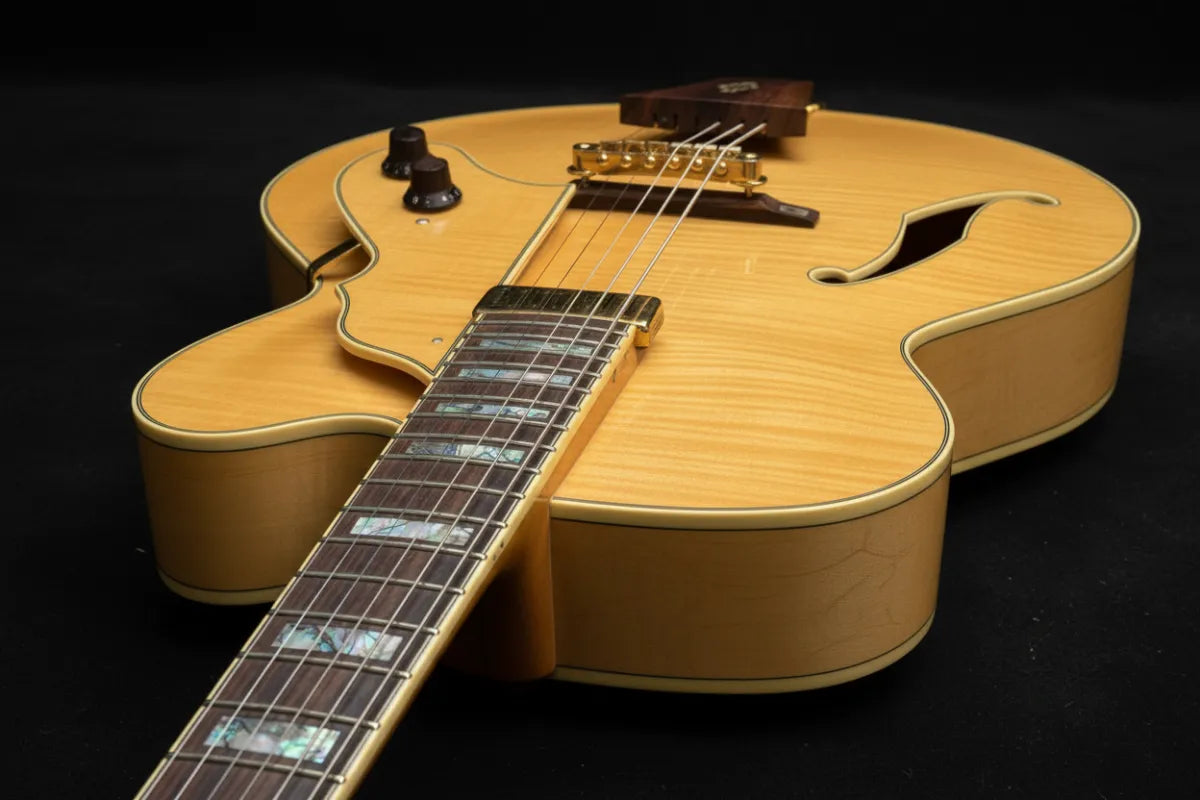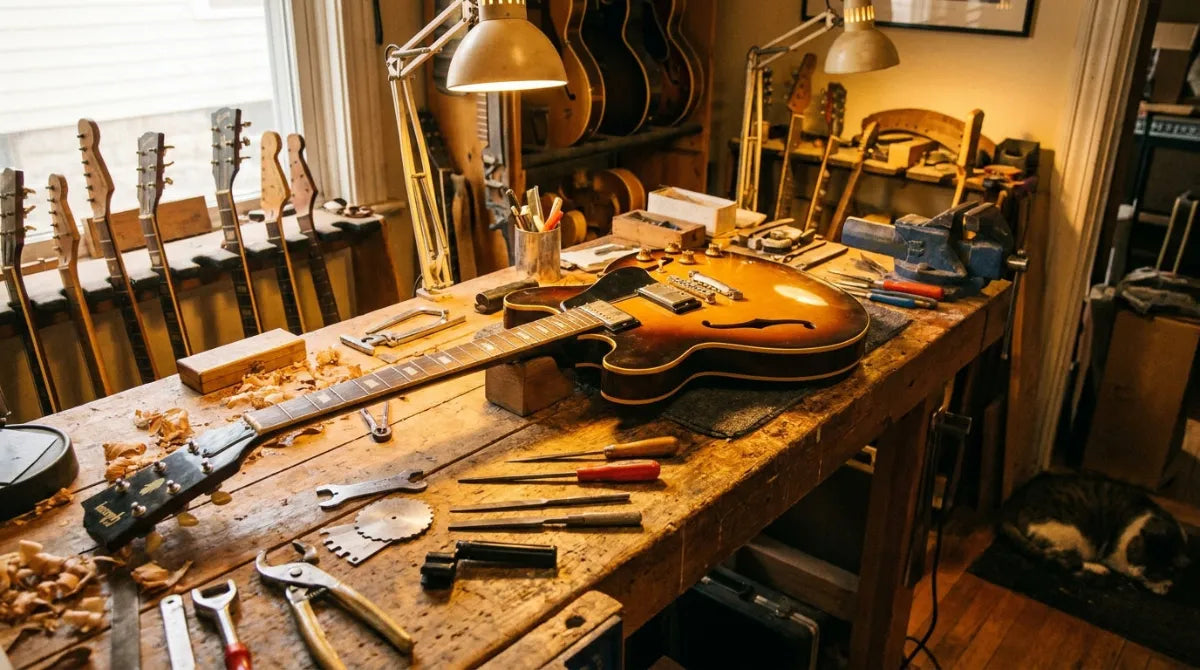



After a long, dry winter, warmer and more humid air can feel like a relief, but it brings its own set of problems for a guitar. Wood that shrank all winter starts taking moisture back in, and that swelling can be just as hard on an instrument as the drying was. At Guitars on Main, we see a steady run of guitars come in each spring and summer with issues that trace straight back to rising humidity.
Here's what actually happens to a guitar in humid air, and what we'd suggest doing about it.
What high humidity does to a guitar
Guitars are mostly wood, glue, and metal, and all three respond to excess moisture in their own way.
Swelling and warping. As the wood absorbs moisture, it expands. On an acoustic, that often means the top domes more than it should, which raises the action and can throw off intonation. On any guitar, a neck that swells unevenly can develop extra relief or a hump where the neck joins the body, leading to buzzing or notes that choke out higher up the fretboard.
Glue joint failure. Excess moisture can soften and weaken the glue holding a guitar together. This is where the more serious problems show up: braces coming loose inside the body, a bridge starting to lift, or seams separating along the sides.
Rust and corrosion. Frets, tuning machines, bridge saddles, and strings are all exposed to whatever's in the air, and humid conditions speed up corrosion. Strings in particular tend to go dead faster in a humid environment.
Mold and mildew. A guitar stored in a case in a damp space, a basement without climate control, is a common example, can develop mold or mildew on the wood or the case lining. Beyond the smell, it's not something you want sitting against your instrument or your hands.
The spring transition is its own challenge
One pattern we see often in our shop: a guitar that dried out over the winter, then swells back up as spring humidity returns. If your guitar suddenly starts buzzing, especially on the lower frets, once the weather warms up, it's often because the neck has shifted with the change in moisture. The fix is usually a straightforward truss rod adjustment to bring the relief back into balance, though it can take a technician's hands to get it right without over-correcting.
Other common spring symptoms include an acoustic top that's swelled enough to raise the action, or intonation that's drifted slightly from where it was in the winter. None of this means anything is wrong with the guitar. It's just wood doing what wood does when the air around it changes. The guitars that end up needing more involved repairs are usually the ones that went through the most extreme swings, very dry all winter, then very humid in the spring, without any humidity control in between.
What we'd suggest for keeping humidity in check
Track your actual conditions with a hygrometer. A room can feel comfortable to you and still be well outside the range that's good for a guitar. A digital hygrometer, like the Music Nomad Hone Guitar Hygrometer, gives you a real number instead of a guess, and it's the easiest way to catch a problem before it becomes an expensive one.
Use a room dehumidifier if you're in a naturally humid space. This is often the simplest fix if your guitar lives in a basement, a room without air conditioning, or anywhere that regularly runs above 55 to 60 percent relative humidity for long stretches. Keeping the room itself in a reasonable range protects everything else stored there too.
Consider a two-way humidity system for the case. Products like the D'Addario Humidipak work in both directions, releasing moisture when the air is dry and absorbing it when the air is too humid, aiming to hold the case around 45 to 50 percent. That makes it a genuinely useful option year-round rather than just a winter tool. Moisture-absorbing packs are another option for a case that runs consistently damp, though they need to be swapped out regularly once they're saturated. You'll find these and other options in our guitar care and accessories collection.
Keep the guitar in its case rather than out on a stand. This cuts both ways with humidity. A closed case with the right accessories inside is a much more stable environment than an open room, whichever direction the air is swinging.
Wipe down strings and hardware after playing. In a humid environment, this small habit does a lot to slow corrosion and keep strings sounding fresh longer.
When it's worth a setup instead of a DIY fix
A good setup, checking neck relief, action, and intonation, can bring a guitar back into shape after it's settled into its new seasonal humidity level. That's usually the right move if the guitar is basically sound but just needs to be dialed back in. It's not a fix for everything, though. A setup can't reseat a loose brace, correct a lifting bridge, or repair glue joints that have actually failed. Those need a repair tech's attention.
If your guitar has gone through a rough winter-to-spring transition and isn't settling down on its own, or if you're noticing buzzing, a bridge that looks like it's lifting, or seams that don't look quite right, we'd rather take a look and tell you honestly what it needs than have you guess. You can find details on our repair and setup services page, and for the flip side of this problem, our guide on protecting your guitar from dry winter air covers what to do once the heat comes back on next fall.
The bottom line
Humidity swings, not just dry air, are what wear on a guitar over time. The most effective thing you can do is keep the swings small: know your actual humidity with a hygrometer, store the guitar in its case, and use a dehumidifier or two-way humidity system if your space runs consistently outside the 40 to 55 percent range. A little consistency across the seasons goes a lot further than reacting after something's already gone wrong.
If you're not sure whether what you're hearing or seeing is a humidity issue or something else, bring it in and we'll figure it out together.