


Don't Fret Over Frets!
There truly is nothing like putting on a pair of your favorite shoes, so comfortable and supportive that you continue wearing them indoors, even while sitting in your favorite lounge chair. They seem to conform to your exact podiatric anatomy, but there is one significant catch: shoes don't last forever; unfortunately, nothing does.
In this way, guitar frets are like shoes. The more frequently and harder we use them, the shorter their lifespan becomes, to the point where wearing them becomes detrimental to our feet, hips, spine, etc. Like worn-out shoes, worn out frets cause major problems for the playability and tone of a guitar.
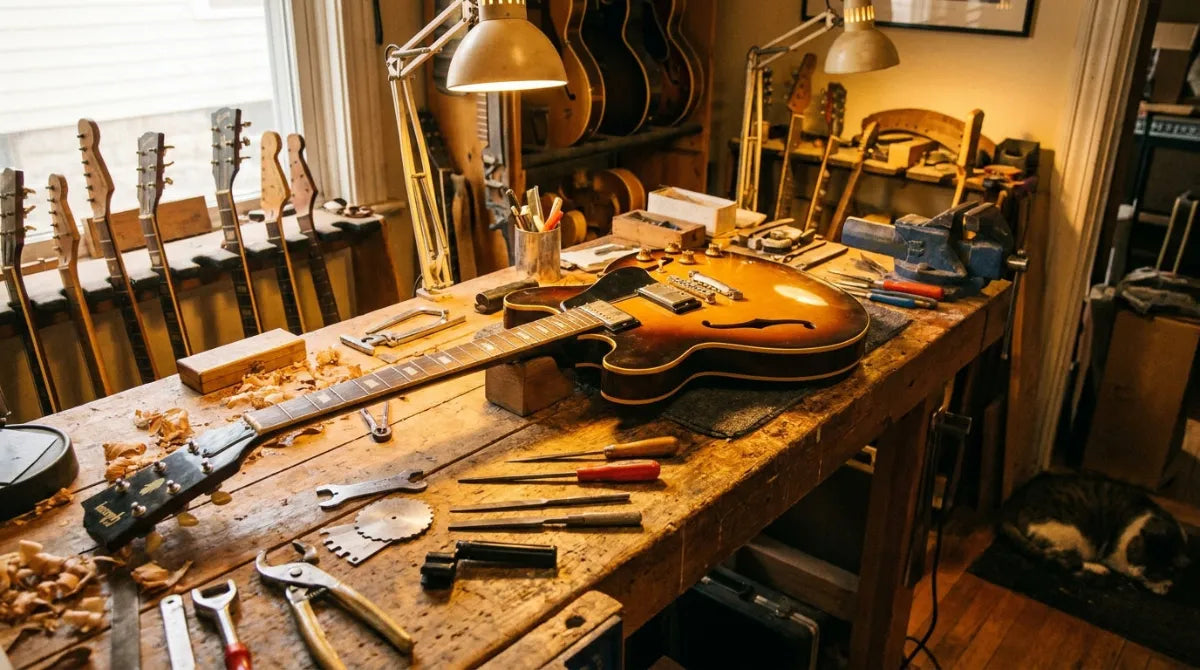
For our feet, this means a new pair of shoes; for our guitars, fortunately, this doesn't mean a whole new guitar. Instead, a leveling, crown and polish, or a complete refret are available options to ensure that your favorite guitar remains in tip-top playing condition right here at Guitars on Main.
Choosing the right fret material and size depends on personal preference and playing style. Experimenting with different types of frets can help determine which material and size best suits your needs.
Guitar frets come in several types, and the differences mainly affect playability, tone, durability, and feel. Below is a clear breakdown of fret materials, different sizes and shapes, the importance of fret crowns, and alternative/specialty frets.
Fret Material
1. Nickel-Silver (NiSilver) Frets
This is the most widely used fret material for a number of reasons. First, nickel frets are known for their smooth texture and attractive shiny appearance. They are generally a mixture of softer metals, like nickel, copper, and zinc, which makes them easy to work with, but the downside is that they do wear out over time, needing frequent level, crown, and polishing with use. They are most common on standard guitars, durable and smooth, but slightly softer than stainless steel, so fretwork costs less than harder fret material.
2. Stainless Steel Frets
This material is getting more and more popular for guitarists for several key reasons. Their durability is unmatched, as is their resistance to wear. Stainless steel frets are several times harder than nickel silver frets, making them somewhat of a luthier's nightmare as a simple crown and polish takes much more time and effort, reflected in repair cost. They offer a brighter tone than nickel frets and are available in all fret sizes. If you're a heavy-handed player who prefers a brilliant tone, choose stainless steel, but know that fretwork will be extremely expensive.
3. Gold Frets
Made from copper alloy, gold frets are a newer, less common option that's good for several reasons. Players with nickel allergies are able to play without discomfort or allergic reactions because they're make nickel-free. They sit right between nickel and stainless steel in hardness and durability, more durable than nickel, softer than stainless steel. As such they provide a balance of workability for luthiers and durability for players. They feature a softer, warmer tone than stainless steel, but wear faster, looking absolutely premier in the process.
Fret Size and Shape

In general, frets vary in height (tall vs. low) and width (narrow vs. jumbo), and different sizes lend themselves to different techniques.
1. Vintage or Narrow Frets
Low and thin, this fret size is easier for playing chords all over the neck and is generally good for players who like to employ subtle bends of a half step or less. The other side of the coin is that it's harder to bend notes a whole step or more. As there is less material in the fret, there is less sustain overall, often a deal breaker for tone seekers.
2. Medium or Medium Jumbo Frets
This common fret size balances height and width in a way that's instantly comfortable for both chording and for bends of a whole step or more. As there is more material than vintage size frets, there is generally more sustain, but some say that comes with slightly less precision than for faster runs.
3. Jumbo or Wide Frets
This fret size is both tall and wide, which makes is great for all string bending and precise left-hand expression in soloing. It is noticeably more difficult to play barre chords, and it will feel bulky for players with smaller hands. Of course, more material means more sustain, so, this, combined with the expression and bendability, this makes jumbo frets the choice for shredders.
4. Extra Jumbo Frets
For those who feel that jumbo is not quite enough, there's the extra jumbo fret size. They are very tall and very. Players can enjoy maximum bending control and fretting hand expression. Of all the aforementioned fret sizes, extra jumbo has the most potential for sustain. Unfortunately, this can feel awkward for rhythm playing, promoting more finger fatigue. Strummers and strictly rhythm guitarists should probably avoid this size. Beyond this, the only larger fret you can put on a guitar is a bass fret, which I personally love, but this may require some woodwork near the tangs.
Fret Crown and Fingerboard Radius
1. Thin Crown
The most common fret top for crowned frets is a smoothly rounded shape with a relatively thin crown center line, the gold standard for smooth bends and accurate intonation. Only a very narrow edge remains flat to keep intonation as true as possible on a guitar.
2. Flat Top Crown
An alternative to this is flat-top or “tapered” frets, which can make sliding or aggressive bending smoother but may feel less traditional to the player. Another drawback to this alternative crowning method is less accurate intonation over the fingerboard, making this an unusual option.
3. Compound Radius Fretboards
Many modern guitars come with multiple radiused fingerboards for easier chording near the nut and more comfortable soloing above the 12th fret. In general, compound radius fretboards often work best with medium jumbo frets to balance chord comfort near the nut and lead guitar playing near the higher frets.
Specialty Fretboards
1. Scalloped Fingerboard
Ritchie Blackmore, John McLaughlin, and Yngwie Malmsteen popularized the scalloped fretboard, where, instead of making the fret taller and taller, wood between the frets is scooped out for a skate-y, nothing but "air under your fingers” feeling, often used in shred guitars for precise bends and vibrato and the ultimate feeling of fretting hand expression. The player gets all the benefits of frets with an even greater depth of fretting hand expression and control. If you have the dexterity and the ear, you can bend and vibrato straight into the guitar fingerboard, making single notes in chords able to be bent and vibratoed. This is an irreversible modification, however; once you start cutting out material, there's no going back.
2. Fretless Fingerboard
One final alternative to frets is no frets at all! Violins, cellos and upright basses have always had fretless fingerboards, so why not guitars? Fretless bass, thanks to players like Jaco Pastorius has been a popular and viable option for decades; only in recent history have fretless guitars been pushed into prominence by players like Guthrie Govan and Ron "Bumblefoot" Thal. Fretless guitars are great for sliding, microtonal play, and for producing a warm, smooth legato tone. For those who have never mastered playing slide guitar, like me, this is a great option. Of course, with the lack of fret material comes the lack of sustain, so playing a fretless instrument does have a steep, but worthwhile learning curve.
Final Thoughts
Personally, I prefer extra jumbo stainless steel frets (the tallest, hardest, widest frets) with a narrow crown, but they are absolutely unforgiving and deadly expensive, both to install and to service. I also love scalloped fingerboards (I did two myself; do NOT try this!) and fretless instruments (I have a fretless six string bass and a fretless Telecaster), so I haven't settled on one magic bullet.
In summary, choose the right fret material (of lack thereof) for durability and tone, the right size and shape for balancing bending ease and chord comfort, the crown for smoothness and playability, or specialty fretboards for unique techniques and tones; there are many excellent reasons why medium-jumbo nickel frets are the most common.